UGH. The big Etsy Success article today (MIS)leads with a pricing formula. Pricing formulas need to have the Miss Cleo "For entertainment purposes only" disclaimer.
"Pricing" formulas give you a number based on what you spent to create an item. Use a formula to calculate your true cost. Know your true cost. If you can't sell what you're trying to sell for enough to cover your true cost and you're not doing it for fun/love/while you watch tv, reevaluate your business.
To PRICE an item, take the number of dollars a customer is willing to pay for that item in a reasonable amount of time. Multiply by 1. If you want to charge more than that number, spend more time on marketing and find customers who are willing to pay more.
Cost times 2? times 4? Well, it's possible. Miss Cleo gets it right, too.

Showing posts with label pricing. Show all posts
Showing posts with label pricing. Show all posts
Thursday, October 28, 2010

Saturday, August 28, 2010
The Problem With Pricing Formulas: Econ 001
Put extremely simply:
Let's say I make and sell mud.
My ingredients are dirt and water.
I find a cheaper dirt supplier with higher quality mud even closer to my house.
My supply costs go down.
My time costs go down.
Why should I charge less for my new nicer mud just because my costs went down?
I could charge the same and make more.
I could charge more and maybe make even more more.
 Better plan:
Look at how much people buy mud like mine.
Look how much they willingly pay.
Look for the most they willingly pay and see when and why they pay that.
Don't look at "Mud for sale: $9 gazillion" signs unless those stores have paying customers.
Don't worry about people who do things that you are physically incapable of doing.
If no one wants mud, consider selling address labels.
Art: Victor Electric Adding Machine by me (JillHannah)
Let's say I make and sell mud.
My ingredients are dirt and water.
I find a cheaper dirt supplier with higher quality mud even closer to my house.
My supply costs go down.
My time costs go down.
Why should I charge less for my new nicer mud just because my costs went down?
I could charge the same and make more.
I could charge more and maybe make even more more.
Better plan:Look at how much people buy mud like mine.
Look how much they willingly pay.
Look for the most they willingly pay and see when and why they pay that.
Don't look at "Mud for sale: $9 gazillion" signs unless those stores have paying customers.
Don't worry about people who do things that you are physically incapable of doing.
If no one wants mud, consider selling address labels.
Art: Victor Electric Adding Machine by me (JillHannah)
Thursday, April 23, 2009
Econ 202: International Business Super-Duper Simplified
I just answered an Etsy forum post (yes, the movers are coming in an hour) and realized it should be an Econ-for-Etsy blog entry. Also, I need to make all these Econ-for-Etsy things into a book and sell it. Oh, EtsyLabs! Storque! Where's my advance?
From the forum:
My response:
No matter what country you are from, it's useful to keep in mind what other countries' goods are considered less expensive and where your currency has little value. People are more likely to buy from you if you are considered a "cheaper" country, but make sure shipping costs don't kill your prices. And if your currency is currently on top? Your fellow countrymen (and countrywomen) are more likely to pay top dollar for your products, so market locally and if somebody from elsewhere wants to pay for what you make, more power to them.
DISCLAIMER: This whole post is SUCH a generalization. There are perfectly fabulous ways to do business from any country, with any country. There are tons of complicating factors I'm not going into. But theses are some super-simplified basics to start. Feel free to yap about the various exceptions and other ideas in comments. Or ask questions. Or tell me I smell. I like comments.
From the forum:
talkingbeads says: Message from U.K. seller
I have just listed a Handbag charm and have priced it at $6 including postage. Is this a good price. Too High or Too Low? Advice Please x
My response:
1)Find out the REAL cost of mailing your items to various locations. You can include handling, etc, though if it gets too high compared to the cost of your item itself you may want to shift and up the charm's cost some to absorb the shipping so people don't freak out when they go to the checkout. Convert to US$. US$ suck right now compared to the pound. Cringe a lot when you see this.
2) Ask "what's the most someone would be willing to pay for this charm?" Try to remove yourself and your attachment to it and just think like a buyer. Convert to US$. Cringe a lot again and realize you're best off selling to other UK people and buying off US sellers because, as previously mentioned, the pound is killing the dollar. So is the euro.
3) Market your brains out. Probably to others on your side of the Atlantic because your shipping will be cheaper and exchange rates won't make your prices seem high so you can actually charge more.
I'm only half joking. US tends not to sell much to Mexico, but the US gets flooded with Mexican goods because of exchange rates and the relative cost of labor, etc. You can make value judgments about free trade and such all you want, but for Etsy sellers, it is what it is and we'll do best if we can understand the market and deal with it accordingly.
For me, the cost of shipping to the EU/UK may or may not be worth it for buyers from those countries to purchase my products. It might be worth a promotional blitz, it might not. Offering cards in Spanish and making a major push for more American business south of the US is probably NOT worth it for me, since the shipping costs will be higher AND the exchange rates mean most people would be willing to pay less.
Isn't economics FUN???
No matter what country you are from, it's useful to keep in mind what other countries' goods are considered less expensive and where your currency has little value. People are more likely to buy from you if you are considered a "cheaper" country, but make sure shipping costs don't kill your prices. And if your currency is currently on top? Your fellow countrymen (and countrywomen) are more likely to pay top dollar for your products, so market locally and if somebody from elsewhere wants to pay for what you make, more power to them.
DISCLAIMER: This whole post is SUCH a generalization. There are perfectly fabulous ways to do business from any country, with any country. There are tons of complicating factors I'm not going into. But theses are some super-simplified basics to start. Feel free to yap about the various exceptions and other ideas in comments. Or ask questions. Or tell me I smell. I like comments.
Wednesday, April 22, 2009
The Price of Starting Over
Moving the big stuff via actual movers tomorrow. Spent weekend in Madison. Head is so far up butt right now you wouldn't believe it.

NiftyKnits wrote a lovely little pricing/econ post this morning in her blog. For people who replace things in their shops when they sell (felted booger-makers), she poses a great way of looking at the lowest price you should charge:
Econ topic for another day: start your pricing by looking at the final product and judging what buyers would be willing to pay. (There's more to it than that, so don't jump down my throat just yet.)
Merry Christmas.
NiftyKnits wrote a lovely little pricing/econ post this morning in her blog. For people who replace things in their shops when they sell (felted booger-makers), she poses a great way of looking at the lowest price you should charge:
A complete stranger asks you to create an item (something you currently sell in your shop). That's not all, they want you to photograph, list and promote this item as well.Now, keep in mind this mental exercise doesn't really apply if you make things when the moment hits and don't change your production (ie don't make more) based on what sells. But if you do, then sweet mother of monkeys! hurry up and ask yourself the "how much would you have to pay me to do it again from scratch?" question and use that as the lowest price you're willing to charge for your item! You can charge as much more as people are willing to pay.
Whew! "Is that all?", you ask.
No, they have one more request: package that item, print a shipping label and drop it off at the post office. Now imagine they want you to do all this for the price you currently have this item listed for in your Etsy shop.
Would you do it happily? Would you grumble? Would you deny this task altogether?
Econ topic for another day: start your pricing by looking at the final product and judging what buyers would be willing to pay. (There's more to it than that, so don't jump down my throat just yet.)
Merry Christmas.
Saturday, April 4, 2009
Econ in Action: Barterer's Dilema, HSN Pricing
A few days ago I was cruising the Etsy forums (much like cruising for chicks, yeah baby) and came across the following:

BirdTrouble makes her bags when inspiration hits, not when they sell or to fill orders or repeats of identical bags. From the forum thread:
That being said, it puts her in the fish swimsuit maker category from my past economic example posts (don't worry if you haven't read them). She already made both the bag and the cosmetics pouch. She can never get back the time and materials she spent on them. They are sunk costs. Now, anything she gets for the bag and pouch is better than the bag and pouch just sitting there, and the goal is to get the most money possible in the least amount of time she's willing to wait.
She's priced the set at $38 for both pieces. Her customer is offering her a lower price (I don't know how much it was, let's say $25?) for just the bag. Now BirdTrouble has to ask herself if it's worth $25 now with the possibility of selling the pouch later, or if she'd rather take the risk of holding onto the set for the chance to sell them together for the full $38. It's a game show:
"BirdTrouble, you have already won $25 from the magic Etsy fishing pond. You can keep that $25, or throw it back for a chance to win $38!"
So what did she choose?
Neither. At the advice of some clever forum responders, BirdTrouble offered her customer a layaway plan to buy the set at the full $38 but over time.
In retail stores, layaway plans are usually a terrible idea for the customer. They involve fees and/or interest and customers always end up paying more in the end for the privilege of waiting to pay it. But in Etsyland, we have the power to make our plans more customer-friendly. In this situation, if BirdTrouble makes the full cost truly the $38 in four monthly installments of $9.50, then even though her customer gets to hold on to the extra money and the few cents it may accumulate in a savings account over that time, BirdTrouble is still way better off than she would have been at $25 or if it had taken more than a few weeks for another customer to buy the set at the full $38.
Thing we can all learn from the story and/or Home Shopping Network: TWELVE MONTHLY INSTALLMENTS OF $19.99! are much easier to swallow than $240, particularly in this lovely current economy of ours. Try offering a pricing plan on some of your more expensive items. But if you don't have a collections agency at your disposal, consider not sending the product until it's paid in full. Just a thought.
BirdTrouble says: A customer is saying they cant afford my bag but they really love it. I have it included with a cosmetic pouch for the total of $38. She's asking if she can buy the bag without the pouch.PERFECT econ example! BirdTrouble was kind enough to be my economic explanation guinea pig, so here goes!
I barly even included the pouch in that cost of the pouch in the price. Gahhhh I dont know what to do, I don't want to lose out on a customer but I dont wan't to sell myself short. What would you do?

BirdTrouble makes her bags when inspiration hits, not when they sell or to fill orders or repeats of identical bags. From the forum thread:
I make when I feel like making. Pouches are easy, bags are fun. It really comes to me when Im walking my stinky dog into the door from a walk and I'm like OH MAN that fabric would look awesome with this, WHERE IS THE PAPER!!!!This is not a bad thing. It's an artist thing and it brings us happiness and I do it all the time with many creative and some non-creative aspects of my own life. I'm not putting it down in any way.
That being said, it puts her in the fish swimsuit maker category from my past economic example posts (don't worry if you haven't read them). She already made both the bag and the cosmetics pouch. She can never get back the time and materials she spent on them. They are sunk costs. Now, anything she gets for the bag and pouch is better than the bag and pouch just sitting there, and the goal is to get the most money possible in the least amount of time she's willing to wait.
She's priced the set at $38 for both pieces. Her customer is offering her a lower price (I don't know how much it was, let's say $25?) for just the bag. Now BirdTrouble has to ask herself if it's worth $25 now with the possibility of selling the pouch later, or if she'd rather take the risk of holding onto the set for the chance to sell them together for the full $38. It's a game show:
"BirdTrouble, you have already won $25 from the magic Etsy fishing pond. You can keep that $25, or throw it back for a chance to win $38!"
So what did she choose?
Neither. At the advice of some clever forum responders, BirdTrouble offered her customer a layaway plan to buy the set at the full $38 but over time.
In retail stores, layaway plans are usually a terrible idea for the customer. They involve fees and/or interest and customers always end up paying more in the end for the privilege of waiting to pay it. But in Etsyland, we have the power to make our plans more customer-friendly. In this situation, if BirdTrouble makes the full cost truly the $38 in four monthly installments of $9.50, then even though her customer gets to hold on to the extra money and the few cents it may accumulate in a savings account over that time, BirdTrouble is still way better off than she would have been at $25 or if it had taken more than a few weeks for another customer to buy the set at the full $38.
Thing we can all learn from the story and/or Home Shopping Network: TWELVE MONTHLY INSTALLMENTS OF $19.99! are much easier to swallow than $240, particularly in this lovely current economy of ours. Try offering a pricing plan on some of your more expensive items. But if you don't have a collections agency at your disposal, consider not sending the product until it's paid in full. Just a thought.
Friday, March 13, 2009
productivity, pricing, and why my cousin is the awesomest person ever
 My best, most marketable product as of right now is probably my business card-sized wallpaper envelopes. I make my wallpaper envelopes by creating a template on heavy cardstock, tracing it onto the back of the wallpaper sample, and cutting each one out by hand with scissors.
Terribly time consuming.
I'd tried using my Xacto or matknife directly with the template, but always ended up destroying the template and making terrible ugly shredded pieces of crap instead of my near-perfect little envelopes. I tried cutting with the scissors around the templates, but I couldn't hold them still propperly. The fastest thing that yielded up-to-my-standards results seemed to be the "trace a bazillion and then cut a bazillion while watching a movie or listening to This American Life podcasts" method, which was particularly annoying for the envelope shapes that I then had to go back in with Mr. Mattknife and make slits for the top to fold in.
I do these in orders of 50 at a time.
Because my process was so slow, it was never worth it to me to sell them for less than $1 a piece. Anything below that and I was in "screw it. I'm not making them anymore" territory.
This is going back to my whole Econ 101 shtick. Once I've made the envelopes, my costs are sunk and any money I get for them is better than having them sit there forever. But because generally make them to order, I can refuse to make more for any less than my time is worth (in this case, $1 an envelope). In theory the best price for me to charge would be some number that maximizes profit where supply meets demand, blah blah blah, but!!!! having to charge over $1 a piece means that if that magic theoretically shiny perfect pricing number is under $1, I can never reach pricing utopia. Oh the horror! The theoretical econ horror! And, more practically, the getting priced out of ever doing wholesale horror!
Enter my cousin and metal artist/blacksmith extraordinaire, Joshua Gilbert. He's pretty awesome and insanely talented and rescues mangy one-eyed evil cats he thinks are sweet and actually makes a living as an artist/metalworkerperson. In exchange for a bunch of the business card sized envelopes with "thank you for your patronage" cards (that's what he wanted), he made me metal templates in two sizes, plus metal folding templates (something I never even imagined) that make folding the envelopes up into nice right angles much quicker.
 Quick crappy photo of the templates and current work in progress on my floor. You get the idea.
I wonder about all those template cutting tools now, like the Fiskars Shapecutter, if they'd be even faster and better than me and my Xacto, or if they even work on negative image templates...If you know, please comment! Please please please!
Back to the econ question: will I lower my prices? No. Because people don't gasp in horror when I say they're $1 each. $1 seems about right. But wholesale orders and bulk orders? Finally. We can do business. 100 doesn't have to still be $100 to be worth making. So how much would you pay for 100 of them? 1000? A gazillion? Life is exciting.

Saturday, December 6, 2008
personal pricing logic of the undead
Doing a bit better as of fairly late last night. I got all of my packages ready for shipping and was perhaps a bit overzealous with the goodies and general package decorating (I'll post a photo if my friend lets me steal his camera before we head to the post office this morning), but I feel a lot better just knowing I could do what had to get done. Being useless is frustrating.
As a result of Mr. Migraine I'd left up my Black Friday-Cyber Monday sale an extra four days with the quick note at the top of my Etsy shop that I was in Migraineland and shipping might be delayed but that meant the sale got extended because I was too dead to take it down. Today, I was going through to bump all of my prices back up and remove the "25 PERCENT OFF" from my titles when I decided perhaps I'm better off leaving most of my cards at $3. I know I personally am more likely to buy from a shop with $3 cards, since I don't like to buy just one at a time and almost $10 when you figure in postage is much more daunting than $8. In fact, I might even buy three cards at $3 each when I would be loathe to buy any from the shop that's selling for $4. Hopefully I'm not the only one thinking like this right now. Also hopefully I have cards that people want and find. That's the huge first part of it. The price just seals the deal. So pretty pretty please if you have a friend you think would like my shop, send them the link, and hopefully this afternoon I'll still feel better enough to work on general whoring (AKA marketing).
As a result of Mr. Migraine I'd left up my Black Friday-Cyber Monday sale an extra four days with the quick note at the top of my Etsy shop that I was in Migraineland and shipping might be delayed but that meant the sale got extended because I was too dead to take it down. Today, I was going through to bump all of my prices back up and remove the "25 PERCENT OFF" from my titles when I decided perhaps I'm better off leaving most of my cards at $3. I know I personally am more likely to buy from a shop with $3 cards, since I don't like to buy just one at a time and almost $10 when you figure in postage is much more daunting than $8. In fact, I might even buy three cards at $3 each when I would be loathe to buy any from the shop that's selling for $4. Hopefully I'm not the only one thinking like this right now. Also hopefully I have cards that people want and find. That's the huge first part of it. The price just seals the deal. So pretty pretty please if you have a friend you think would like my shop, send them the link, and hopefully this afternoon I'll still feel better enough to work on general whoring (AKA marketing).
Friday, November 28, 2008
Holy Sales, Batman!

QUICK "Black Friday" update before I go out and brave the live shopping world myself with my brother and his fabulous girlfriend (something in the past my family has avoided but I've always kind of wanted to do, just because it's there and entertaining in a sick, crazy way):
Lots of places will be pricing items below cost today. I used to work at Circuit City, and we could see what the cost to the store was of an item (they estimated in labor and crap, too). The day after Thanksgiving, one of the managers made a big deal out of showing us a bunch of the "doorbusters" and other random sale items that were selling for significantly less than the cost to the store. So why did the store choose to "lose" money on these items? These were not things that had been sitting on the shelves, where any sale would be making more money than the $0 they were currently pulling in (like I talked about last entry). For the Circuit City model (and many other stores like it), they pull you in with some main big fabulous deal that really is a deal, but then count on you buying accessories like batteries, remote controls, blank CDs, software, etc. where they charge way more than cost and make up for the loss on the initial item and then some.

Can you do that? I'm not doing it so much in my shop. I'm going with the "everything on sale, things that already exist can go to any price because they already exist and things that would need to be made can go very close to cost and no matter what it's good to get people into my store and buying because if I can get them hooked on my product while it's cheap then later when it's not on sale they'll come crawling back because my wallpaper envelopes are made out of crack and I use really nice papers that are laced with heroin*" method myself, but if you think creatively, I'm sure there are ways of using the Circuit City method in your shop, too. Or the drug dealer method. That works, too.
Now where are those leftover cinnamon rolls?
*no actual drugs in any of my products, I'm afraid, but if you're a paper or texture nerd like me, they are fairly addictive.
Photos (items for sale on Etsy):
grey gardens ava bag by cookoorikoo
brass mushroom earrings by carolinableu
Monday, November 24, 2008
PRICING superduper simplified
I've written about pricing before. I will probably write about it again. I was an economics major at Oberlin College for three years (my "taking time off" for a variety of reasons became permanent, but that's another story), so I do actually know what I'm talking about.
This is the unbelievably simplified version of how to price the things you sell. I should charge you for it, but I'm not, so go buy crap from my shop instead.
If you already made it and it is sitting around and there is only one like it (usually paintings, sculpture, some jewelry, and anything else that is already done and you can't or won't be making more similar to it based on its sale) then you want to choose your price based on the most you think someone will pay in an amount of time you're willing to wait to get paid.
That's it. I don't care how much your materials cost or how much time it took or any of that. The thing is already made. You already spent that money and time. It's gone. "Sunk" as they say in Econoland. Now it's just a matter of how long it will sit on your shelf. Are you willing to wait a longer amount of time in hopes that someone will pay a higher price? Or do you price it lower so it sells faster? Your choice. But remember: 1) however much it finally sells for is more than the $0 it is currently making you and 2) unless you are selling milk and eggs, not everybody will want your item at any price, no matter how low. There may be someone out there who really wants and is willing to pay a higher price for your whatever, but if she never knows it exists, putting it on sale a dozen times for the wrong audience won't do you any good.

If you already made it but you will make more based on the sale of this one or if you only make it after it sells or if you adjust how much you make based on how much you sell in any way, shape or form, pricing is a bit harder. You're actually looking for the point where supply meets demand. I'm not going into how to collect extensive pricing data right now, even though that's the real way to figure this out. You need to know if you charge $20 and you sell 5, how many would you sell by charging $15? If you sell 6 at $15, you may think "great, I sold one more!" but it's not great because you make $100 selling 5 at $20 (5 x 20 = 100) and only $90 selling 6 at $15 (6 x 15 = 90).
 Can you still sell 5 at $23? $25? When do people buy less based on price? Data data data. And even that is hard to know for sure since there are so many other things going on, like how much you're advertising and holidays and the economy and and and!!
So! Here's the easy version for you: figure out how much each item costs you to make. I always like to figure in a little extra to account for my many mess-ups along the way, since they are a part of the cost of making my cards. Then figure how much time it takes you to make each thing. Give yourself a minimum wage (your particular government's, a "living wage," or sweatshop labor rates are all good places to start). Add those two numbers together. Now don't charge less than that. That's what it's worth to you to make more.
EVERYBODY: Look at what other people with similarish items charge. Look at how many sales they have and when. Look at what they're selling.
 Just because somebody is charging a lot for something in your category doesn't mean anybody is buying at that price. It can be scary to see the people at the ends of the pricing spectrum, but look at their sales numbers. How many more sales are the people at the bottom getting than the people in the middle? If it's not a lot, then the people in the middle are probably making more money. If the people at the bottom are selling two or three times more than the people in the middle, then maybe you should be pricing at the bottom, since you'll most likely make more money total. If the people at the top of the spectrum aren't selling anything, then it's not worth it to price at the top of the spectrum. But if the people at the top are selling regularly, it might be worth it to price towards the top because your sales will still move and that may be a lovely place for supply to meet demand.
Now go! Price things! And buy my business card sized "thank you" notes to include in all the wonderful items you are about to sell (I have tons more not listed, so please convo me if you're interested)
photos (all items for sale on Etsy):
Original Mixed Media Artworks by TwoHiddenHeads
1900 Story County Bank of Ames, Iowa, Check from Artouette
a paradox - super mario question block cufflinks by pixelparty
Money Bags Pinback Button, Badge by catlover1
Thursday, September 4, 2008
Swimming in the Data Pool
Ok, it's mini-pricing lesson time, but this one will be very mini and very simple, to be expanded later possibly by request and/or payment, as I'm looking for ways to make more money and I see how much the few people selling spreadsheets are making on Etsy and I think that I need to start tapping that market, too, but in the places it's clearly not even being tapped.
Mini-lesson of the day:
Pool your data.
 This goes well as a pun with my one-of-a-kind hand-sewn fish swimsuit seller, so let's go back to her. It turns out, she's not the only one on Etsy selling fish swimsuits. Of course, no one else's fish swimsuits are exactly like her fish swimsuits, but there's a school of sellers around and they've even started a team called Team Swimmy Suit. They want to pool their data because some girl with a blog told them that was a good idea, but they don't know what this means or how to do it.
Here's how to do it.
Make a spreadsheet. Google Docs is wonderful for this because you can create a single online spreadsheet that everybody is allowed to edit, either by invitation only or by making it open access.
On that spreadsheet, you want to make places to enter the date the item sold, the price for which the item sold (how you want to deal with shipping is up to you, but I like to give it its own column), and the very general type of item. (Oh, dear lord, she made an example!) For fish bathing suits, the team might decide to split it up into small, medium, and large with columns for one-piece versus two-piece and extra places to check-off special characteristics that might effect the price, like custom, recycled, or jewel-encrusted. (Team SwimmySuit example. No, I really didn't have time for this.)
Then, you want as many people as possible to fill in as many sales as possible. The more data you have, the better your pricing info will be. Lucky for everybody, it doesn't matter if you haven't been keeping track of your sales thus far, since Etsy does it for you on your sold orders page. In theory, everything you need to fill out a spreadsheet should be there: date sold, price (with shipping separate), and what the thing was.
When you have a lot of data, it's time to analyze. It's up to you what constitutes a lot...How frequently do these items sell and how many people sell them and how wide is the range of what's out there? Fish bathing suits may be less common than felted boogers may be less common than beaded earrings. You know your craft. Just keep collecting data after you've started analyzing, too.
Hopefully, someone on your team has taken stats 101. If not, find out if someone on your team is sleeping with someone who has taken stats 101, or is the parent of someone who has taken stats 101. If that, too fails, pay someone like me to do it.
The easiest and most useful stuff for you to learn from the little exercise is how many fish swimsuits sold over time for each price range. That's the info you can then use to decide where to price your own items at the real true "bestish" pricing point, or at least the closest thing you're ever going to get to it.
You'll also want to pull out of your data pool analysis whether or not your extra column check boxes had any effect on the price. There's shmancy stats things you can do involving "r squared" and other crap, or you can just tell the spreadsheet software to do certain things if a column has a certain answer in it and see if the final totals change (which is why I no longer remember any formulas I learned in stats or econometrics).
A good stats-knowing person will look at the data in a whole bunch of different ways and see what sorts of other useful things pop out, too. Holiday trends, time trends, if a certain user's items always sell for significantly more or less than other people's and taking them out makes the rest of the numbers make more sense, etc. I'm too ADDesque to do this crap all the time, but I do find it interesting in short spurts.
In the end, even with all this wonderful information, your pricing will still be up to you. It will never be perfect and will more likely be a range than a number, plus people may hold onto "people pay more for recycled fish swimsuits" like a superstition even if the data proves otherwise. But if you make something even vaguely homogeneous with a team, jump into the pool. It can't hurt.
Mini-lesson of the day:
Pool your data.
 This goes well as a pun with my one-of-a-kind hand-sewn fish swimsuit seller, so let's go back to her. It turns out, she's not the only one on Etsy selling fish swimsuits. Of course, no one else's fish swimsuits are exactly like her fish swimsuits, but there's a school of sellers around and they've even started a team called Team Swimmy Suit. They want to pool their data because some girl with a blog told them that was a good idea, but they don't know what this means or how to do it.
Here's how to do it.
Make a spreadsheet. Google Docs is wonderful for this because you can create a single online spreadsheet that everybody is allowed to edit, either by invitation only or by making it open access.
On that spreadsheet, you want to make places to enter the date the item sold, the price for which the item sold (how you want to deal with shipping is up to you, but I like to give it its own column), and the very general type of item. (Oh, dear lord, she made an example!) For fish bathing suits, the team might decide to split it up into small, medium, and large with columns for one-piece versus two-piece and extra places to check-off special characteristics that might effect the price, like custom, recycled, or jewel-encrusted. (Team SwimmySuit example. No, I really didn't have time for this.)
Then, you want as many people as possible to fill in as many sales as possible. The more data you have, the better your pricing info will be. Lucky for everybody, it doesn't matter if you haven't been keeping track of your sales thus far, since Etsy does it for you on your sold orders page. In theory, everything you need to fill out a spreadsheet should be there: date sold, price (with shipping separate), and what the thing was.
When you have a lot of data, it's time to analyze. It's up to you what constitutes a lot...How frequently do these items sell and how many people sell them and how wide is the range of what's out there? Fish bathing suits may be less common than felted boogers may be less common than beaded earrings. You know your craft. Just keep collecting data after you've started analyzing, too.
Hopefully, someone on your team has taken stats 101. If not, find out if someone on your team is sleeping with someone who has taken stats 101, or is the parent of someone who has taken stats 101. If that, too fails, pay someone like me to do it.
The easiest and most useful stuff for you to learn from the little exercise is how many fish swimsuits sold over time for each price range.
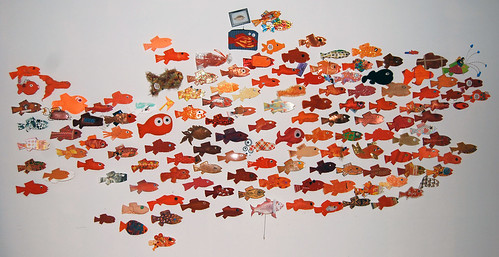 That's the info you can then use to decide where to price your own items at the real true "bestish" pricing point, or at least the closest thing you're ever going to get to it.
You'll also want to pull out of your data pool analysis whether or not your extra column check boxes had any effect on the price. There's shmancy stats things you can do involving "r squared" and other crap, or you can just tell the spreadsheet software to do certain things if a column has a certain answer in it and see if the final totals change (which is why I no longer remember any formulas I learned in stats or econometrics).
A good stats-knowing person will look at the data in a whole bunch of different ways and see what sorts of other useful things pop out, too. Holiday trends, time trends, if a certain user's items always sell for significantly more or less than other people's and taking them out makes the rest of the numbers make more sense, etc. I'm too ADDesque to do this crap all the time, but I do find it interesting in short spurts.
In the end, even with all this wonderful information, your pricing will still be up to you. It will never be perfect and will more likely be a range than a number, plus people may hold onto "people pay more for recycled fish swimsuits" like a superstition even if the data proves otherwise. But if you make something even vaguely homogeneous with a team, jump into the pool. It can't hurt.
Wednesday, April 23, 2008
Econ 101: Jill gets sick of dumb pricing advice
I am not a brilliant pricer. I haven't mastered magic numbers for my shop. I haven't spent enough time researching it, but I have the advantage of knowing the economic theory behind it. It has nothing to do with the cost of my time and supplies multiplied by a magic number. In fact, for products I've already made, those things should barely come into account.
WHAT?
Yes. Revolutionary. And a little bit counter-intuitive.
Maybe you never took Econ 101. Maybe it made no sense. Maybe you hated it. But you've heard of "supply and demand." The part of supply and demand we care about right now is that a buyer will want to spend less money and you want to make more money.
Now let's do an imaginary Etsy example.
Let's say you make one-of-a-kind hand-sewn fish swimsuits. Even if they are free, some buyers still won't want them because they don't have fish, or their fish can't wear Lycra, or they just don't like your particular style. Fine.
Let's say this month you made 25 fish swimsuits. If you keep lowering your prices and your fish swimsuits are still not selling, you're probably at the point where all the people who have found your shop and would actually want to buy your fish swimsuits at any price have already made their purchases. Go advertise, fix your photos, change your product line, etc. Lowering your prices more probably won't help. After all, you aren't the only fish swimsuit seller and there is a limited total number of people who need handmade fish swimsuits in their lives.
But what if those 25 suits flew off the shelves at $1 a piece? Then you made $25. Swell.
The next month you again make 25 fish swimsuits. You want to see how much you can possibly charge, so you start with your price at $1,000 a suit and lower it until you get a sale (NOTE: this is not something I'm advising you do, since it's not like Etsy or your personal site has the traffic to make this really work, though it might be fun to try on one item just to see). Your sale finally comes in at $250. Holy crap! Someone paid $250 for a fish swimsuit! You rule!
So you should start charging $250 for your fish swimsuits and list one a day.
NO. WRONG. BAD.
Because let's say you lowered it to $200, maybe you'd sell two a month (that's $400 total per month, FYI). And what if you lowered it to $100? Holy crap, you just sold 10 of them! that's $1000 a month! $75? 20 of them, giving you $1,500!
"Ok, so then I want to lower my price until everything sells."
NO. WRONG. BAD AGAIN.
Because now let's say in order to sell all 25 of them, you have to lower your price to $50, and that gives you $1,250. When you were charging $75, you only sold 20 of your 25 sweaters, but you made $1,500. That's an extra $250. $250 buys a lot of really cute felted crap from other Etsy sellers.
"So, wait. The best price to charge is some arbitrary-seeming number that probably doesn't sell all the stuff in my shop but also isn't the the most people are willing to pay and has nothing to do with how much it cost me to make it?"
YES. If it's already made and it's not doing you any good to hold onto it. Because once you've made it, all of those "how much it cost me, how much time it took, etc" things become what the econ world officially calls fixed costs or sunk costs. They don't change if you get $1 or $10,000 for the item. As a person who handmakes things myself, I understand the sentimental attachment involved, but I use that as a sort of base worth it has to me, so no matter what I'm not willing to part with it for less than that amount.
More on fixed costs: if I spend twice the time making a card because I did the whole thing with my left hand because I thought it would be more artistic and force me to be more mindful of my creation if I made the card lefty, and it comes out looking almost the same but a little worse than the card I made immediately before it with my right hand, a buyer is not going to pay me twice as much for the one lefty card to cover the two righty cards I could have made in that same amount of time.
"But it took me twice as long!"
Yes, please, whine like that to the buyers, too. If you're doing processes that take double the time and really sinking your teeth into the integrity (note: this is different from the actual product quality, which would lead to repeat customers. I'm talking about things that aren't visible in the final product, like the fight I had with my printer because it's my grandpa's old printer but I'm loathe to get rid of it because part of me thinks he haunts it except not really) then you need to be doing it for the integrity and not expect your buyers to pay you more, too.
"How the fuck do I find this arbitrary-seeming perfect pricing number?"
How do I get a flat stomach by June? Sorry I don't have a quick-fix. Unfortunately, you need data. And even all the data in the world won't get you a perfect solution, because even if you had an entire year's worth of data, there are all sorts of other things that come into play (maybe a major movie comes out one month in which Brad Pitt makes out with a fish wearing a fish swimsuit that's totally like the kind you make! Or maybe you finally re-do all your pictures and your sales jump up) and how are you supposed to know how much that changed things? And this is all assuming you have a fairly homogeneous (most of your crap is similar) product line. How the hell do you price that one random item? Yeah, good luck with that. But as a start, try playing around with your pricing in an orderly fashion. See how many items you've been selling and your total income week by week or month by month for the lasts year or six months or however long you've been on Etsy. Now try raising your prices a bit at a time week by week and see what it does to your income. If it goes up, keep going up. If it goes down, try lowering. See if you sell more. If not, don't keep lowering. It's like that lemonade stand computer game (less than 20 years ago I played it on an Apple IIe with no graphics...I'm too young to feel this old...) only your shop is your lemonade stand. You can play a free version online here.
What would be really nice is if sellers got together and could share data, or if Etsy could release some data to sellers. Maybe I'll ask my Aquatic Animal Lycra Team (AALT) to start sharing data on Google Docs or something so we can all have a better idea about pricing, but that might be considered price-fixing and might be a little illegal. Still, if just a few of us pooled resources, how is that any different from standard market research? Clearly, I need a marketing department. Where's my dog? He could totally do it.*
Ok, deep breath.
Now, let's say you make felted boogers. Hundreds of them. You frequently make them to order, and you can easily make more or less depending on what people want and seem to be buying. You are the seller who needs to worry about the time it takes to make each item and your materials costs and things. You are much more complicated. I'm too tired to deal with you right now, but if you're lucky, I might try to figure out a way to make the theoretical crap actually practical and useful another day.
But the more immediate reason I bring you up, oh maker of felted boogers, is that it will be obvious to you that if you are at the point where all the people who know about your shop and want your felted boogers have already purchased them, you stop making them until the demand returns. You work on your advertising and your photos, or maybe you stalk Alchemy and notice a lot of requests for resin boogers and try going into the resin booger business as a supplement or instead. And this is obvious to you because you weren't covering your variable costs. Those are the things that change with the selling of each item, and since you make each item to sell each item, materials and time kind of creep in there for you. They create a bit of a pricing floor, below which it's not worth it to you to be felting boogers.
What do I mean by a FLOOR?
A level below which it is no longer worth it to you to sell your crap.
So when we go back to our friend, the fish swimsuit maker, if she's not moving her stock of 25 swimsuits, she'd better not be making any more, either. That would be dumb. When people talk about pricing things and say that they "can't charge enough to cover their materials and pay themselves a decent wage," I know this is an asshole response, but THEN DON'T MAKE IT ANYMORE! If you're doing it because you love the art, then you're going to have to consider love part of your salary. It goes in the bag with integrity. If you're trying to make a living, go play Lemonade Stand, keep track of your weekly and/or monthly sales, stalk people who sell similar items and their sales, and if you're still in the red, your magic highest number may still be red! Hopefully, it will be huge and gorgeous and positive and you can quit your day job and buy all 25 fish swimsuits. I hear that shop is having a clearance sale.
*This is assuming "Market research" involves barking at other dogs and pawing my face at 4 AM
WHAT?
Yes. Revolutionary. And a little bit counter-intuitive.
Maybe you never took Econ 101. Maybe it made no sense. Maybe you hated it. But you've heard of "supply and demand." The part of supply and demand we care about right now is that a buyer will want to spend less money and you want to make more money.
Now let's do an imaginary Etsy example.
Let's say you make one-of-a-kind hand-sewn fish swimsuits. Even if they are free, some buyers still won't want them because they don't have fish, or their fish can't wear Lycra, or they just don't like your particular style. Fine.
Let's say this month you made 25 fish swimsuits. If you keep lowering your prices and your fish swimsuits are still not selling, you're probably at the point where all the people who have found your shop and would actually want to buy your fish swimsuits at any price have already made their purchases. Go advertise, fix your photos, change your product line, etc. Lowering your prices more probably won't help. After all, you aren't the only fish swimsuit seller and there is a limited total number of people who need handmade fish swimsuits in their lives.
But what if those 25 suits flew off the shelves at $1 a piece? Then you made $25. Swell.
The next month you again make 25 fish swimsuits. You want to see how much you can possibly charge, so you start with your price at $1,000 a suit and lower it until you get a sale (NOTE: this is not something I'm advising you do, since it's not like Etsy or your personal site has the traffic to make this really work, though it might be fun to try on one item just to see). Your sale finally comes in at $250. Holy crap! Someone paid $250 for a fish swimsuit! You rule!
So you should start charging $250 for your fish swimsuits and list one a day.
NO. WRONG. BAD.
Because let's say you lowered it to $200, maybe you'd sell two a month (that's $400 total per month, FYI). And what if you lowered it to $100? Holy crap, you just sold 10 of them! that's $1000 a month! $75? 20 of them, giving you $1,500!
"Ok, so then I want to lower my price until everything sells."
NO. WRONG. BAD AGAIN.
Because now let's say in order to sell all 25 of them, you have to lower your price to $50, and that gives you $1,250. When you were charging $75, you only sold 20 of your 25 sweaters, but you made $1,500. That's an extra $250. $250 buys a lot of really cute felted crap from other Etsy sellers.
"So, wait. The best price to charge is some arbitrary-seeming number that probably doesn't sell all the stuff in my shop but also isn't the the most people are willing to pay and has nothing to do with how much it cost me to make it?"
YES. If it's already made and it's not doing you any good to hold onto it. Because once you've made it, all of those "how much it cost me, how much time it took, etc" things become what the econ world officially calls fixed costs or sunk costs. They don't change if you get $1 or $10,000 for the item. As a person who handmakes things myself, I understand the sentimental attachment involved, but I use that as a sort of base worth it has to me, so no matter what I'm not willing to part with it for less than that amount.
More on fixed costs: if I spend twice the time making a card because I did the whole thing with my left hand because I thought it would be more artistic and force me to be more mindful of my creation if I made the card lefty, and it comes out looking almost the same but a little worse than the card I made immediately before it with my right hand, a buyer is not going to pay me twice as much for the one lefty card to cover the two righty cards I could have made in that same amount of time.
"But it took me twice as long!"
Yes, please, whine like that to the buyers, too. If you're doing processes that take double the time and really sinking your teeth into the integrity (note: this is different from the actual product quality, which would lead to repeat customers. I'm talking about things that aren't visible in the final product, like the fight I had with my printer because it's my grandpa's old printer but I'm loathe to get rid of it because part of me thinks he haunts it except not really) then you need to be doing it for the integrity and not expect your buyers to pay you more, too.
"How the fuck do I find this arbitrary-seeming perfect pricing number?"
How do I get a flat stomach by June? Sorry I don't have a quick-fix. Unfortunately, you need data. And even all the data in the world won't get you a perfect solution, because even if you had an entire year's worth of data, there are all sorts of other things that come into play (maybe a major movie comes out one month in which Brad Pitt makes out with a fish wearing a fish swimsuit that's totally like the kind you make! Or maybe you finally re-do all your pictures and your sales jump up) and how are you supposed to know how much that changed things? And this is all assuming you have a fairly homogeneous (most of your crap is similar) product line. How the hell do you price that one random item? Yeah, good luck with that. But as a start, try playing around with your pricing in an orderly fashion. See how many items you've been selling and your total income week by week or month by month for the lasts year or six months or however long you've been on Etsy. Now try raising your prices a bit at a time week by week and see what it does to your income. If it goes up, keep going up. If it goes down, try lowering. See if you sell more. If not, don't keep lowering. It's like that lemonade stand computer game (less than 20 years ago I played it on an Apple IIe with no graphics...I'm too young to feel this old...) only your shop is your lemonade stand. You can play a free version online here.
What would be really nice is if sellers got together and could share data, or if Etsy could release some data to sellers. Maybe I'll ask my Aquatic Animal Lycra Team (AALT) to start sharing data on Google Docs or something so we can all have a better idea about pricing, but that might be considered price-fixing and might be a little illegal. Still, if just a few of us pooled resources, how is that any different from standard market research? Clearly, I need a marketing department. Where's my dog? He could totally do it.*
Ok, deep breath.
Now, let's say you make felted boogers. Hundreds of them. You frequently make them to order, and you can easily make more or less depending on what people want and seem to be buying. You are the seller who needs to worry about the time it takes to make each item and your materials costs and things. You are much more complicated. I'm too tired to deal with you right now, but if you're lucky, I might try to figure out a way to make the theoretical crap actually practical and useful another day.
But the more immediate reason I bring you up, oh maker of felted boogers, is that it will be obvious to you that if you are at the point where all the people who know about your shop and want your felted boogers have already purchased them, you stop making them until the demand returns. You work on your advertising and your photos, or maybe you stalk Alchemy and notice a lot of requests for resin boogers and try going into the resin booger business as a supplement or instead. And this is obvious to you because you weren't covering your variable costs. Those are the things that change with the selling of each item, and since you make each item to sell each item, materials and time kind of creep in there for you. They create a bit of a pricing floor, below which it's not worth it to you to be felting boogers.
What do I mean by a FLOOR?
A level below which it is no longer worth it to you to sell your crap.
So when we go back to our friend, the fish swimsuit maker, if she's not moving her stock of 25 swimsuits, she'd better not be making any more, either. That would be dumb. When people talk about pricing things and say that they "can't charge enough to cover their materials and pay themselves a decent wage," I know this is an asshole response, but THEN DON'T MAKE IT ANYMORE! If you're doing it because you love the art, then you're going to have to consider love part of your salary. It goes in the bag with integrity. If you're trying to make a living, go play Lemonade Stand, keep track of your weekly and/or monthly sales, stalk people who sell similar items and their sales, and if you're still in the red, your magic highest number may still be red! Hopefully, it will be huge and gorgeous and positive and you can quit your day job and buy all 25 fish swimsuits. I hear that shop is having a clearance sale.
*This is assuming "Market research" involves barking at other dogs and pawing my face at 4 AM
Poll-tacular
I'm in the Etsy Virtual Lab for a shop critique (not my own) and we're discussing the issue of round numbers for prices. It's come up before. I'm currious, since I tend to like weird decimals to avoid the big glob in price-sorted searches, but I think I'm in the minority. So vote. If it turns out everybody is of a different opinion, I will gladly change my ways. I think other people would be interested in this info, too. Feel free to leave questions and comments.
Subscribe to:
Posts (Atom)